7 Scientific Principles Behind Ultraclear Laser Treatment
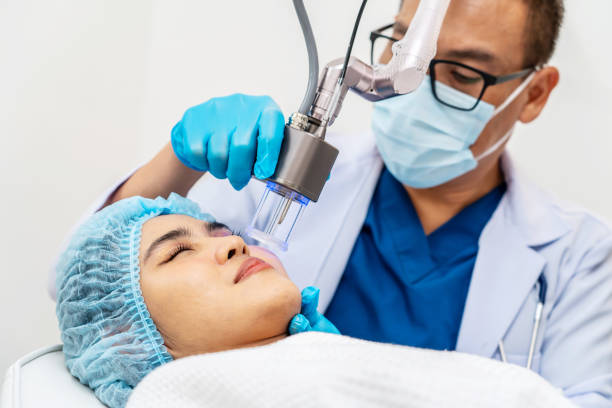
Laser resurfacing is based on a carefully controlled interaction between light and tissue. UltraClear uses a 2910 nm erbium doped fluoride glass fiber laser, a wavelength that is strongly absorbed by water in skin. This allows energy to create precise microscopic treatment zones while controlling how deeply tissue is affected.
The science behind UltraClear involves wavelength selection, water absorption, fractional ablation, thermal control, tissue repair, collagen remodeling, and precise energy delivery.
1. Wavelength Determines How Energy Interacts With Skin
The first principle is selective absorption. Skin contains substantial water, and water acts as an important chromophore for mid infrared laser energy. UltraClear operates at 2910 nm, a wavelength positioned near strong water absorption.
When the laser reaches water within tissue, the energy is absorbed efficiently. Rapid energy absorption produces heating. Because the interaction is closely linked to water content, the laser can create controlled microscopic treatment zones rather than simply heating the entire surface.
For a closer look at the molecule involved in this interaction, water is the main tissue component responsible for absorbing this wavelength.
2. Ablation Removes Precisely Targeted Tissue
UltraClear is an ablative laser, meaning its energy can remove selected portions of the epidermis and dermis. Research on the 2910 nm fiber laser has demonstrated adjustable treatment depths, ranging from superficial effects to deeper fractional ablation. This allows practitioners to tailor treatment according to concerns such as uneven texture, photodamage, wrinkles, and scars.
The principle is straightforward. Controlled removal creates a defined area of tissue injury, and the body responds by repairing that area. The resulting healing process is an important part of the skin renewal effect.
3. Fractional Treatment Controls Coverage
Fractional laser treatment does not remove tissue across the entire treated surface. Instead, it creates microscopic columns or treatment zones separated by areas of untreated skin.
This pattern provides an important biological advantage. The surrounding untreated tissue remains viable and can support the recovery process. Clinical studies of the 2910 nm fiber laser have examined different treatment depths and coverage levels, demonstrating how treatment parameters can be adjusted for different degrees of photodamage.
Fractional delivery therefore provides a way to balance tissue remodeling with controlled treatment coverage.
4. Thermal Control Shapes the Tissue Response
Laser resurfacing involves more than removing tissue. Heat generated around each treatment zone can also influence the biological response. The amount of residual thermal effect depends on wavelength, pulse characteristics, energy, and tissue interaction.
UltraClear is engineered around controlled ablation and coagulation. Its manufacturer describes the technology as a cold ablative fiber laser, designed to deliver energy efficiently while limiting unnecessary thermal spread.
Research involving histological analysis of the 2910 nm fiber laser has demonstrated an ablative microchannel surrounded by a defined zone of coagulation.
These variables help match treatment intensity with individual clinical needs and anatomy.
5. Controlled Injury Initiates Skin Repair
Ablative resurfacing works partly by creating a controlled tissue injury. Once the laser removes microscopic areas of skin, the body begins a wound healing response involving inflammation, cell migration, new extracellular matrix production, and tissue remodeling.
This response is central to the science of resurfacing. Biological repair continues afterward as the skin restores the treated areas.
For a deeper explanation of the structural protein involved in this process, collagen provides strength and support within connective tissue and is an important component of the dermis.
Clinical research on the 2910 nm fiber laser has reported improvement in photodamaged skin and acne scarring following treatment, supporting the role of controlled injury and subsequent remodeling in the overall treatment process.
6. Collagen Remodeling Can Improve Skin Structure
The dermis contains collagen, elastin, extracellular matrix components, and other structures that contribute to skin strength and texture.
When controlled laser energy reaches the dermis, the resulting thermal and ablative effects can initiate remodeling. During healing, fibroblasts and other cells participate in the production and organization of new extracellular matrix components.
The visible result is therefore not produced solely by removing damaged surface tissue. Changes occurring during healing can contribute to smoother texture, improved appearance of wrinkles, and refinement of scar contours over time.
Research involving deeper 2910 nm laser treatment has also examined tissue coring and microchannels extending into the mid and deep dermis, with histological findings showing defined ablation and surrounding coagulation.
7. Fiber Delivery Improves Energy Precision
UltraClear uses fluoride glass fiber technology to transmit the 2910 nm wavelength directly to the treatment site.
This approach is significant because water strongly absorbs wavelengths around 2910 nm. Efficient fiber transmission allows the energy to reach the treatment area with a controlled beam profile.
The system is designed to support rapid, precise delivery and multiple treatment modes. Depending on the selected module and settings, treatment can be directed toward superficial photodamage, epidermal changes, deeper dermal remodeling, or tissue coring.
The practitioner can control parameters such as depth, density, energy, and treatment pattern.
Why These Scientific Principles Matter
UltraClear combines several principles rather than relying on a single mechanism. The 2910 nm wavelength determines how strongly energy interacts with tissue water. That interaction enables controlled ablation. Fractional delivery limits the area treated at one time, while thermal control influences the surrounding tissue. The resulting healing response can then support collagen remodeling and gradual changes in skin texture.
Clinical studies have reported improvement in photoaging and acne scarring after treatment with the 2910 nm fiber laser. One study of advanced facial photoaging also evaluated full face and neck resurfacing and reported measurable aesthetic improvement after a series of treatments.
For people researching ultra clear laser treatment, understanding these principles provides a clearer picture of what the technology is designed to do. It is a controlled resurfacing approach that combines wavelength science, precise energy delivery, fractional treatment, and the body's natural repair processes.


Comments
Post a Comment